
Innovative plant science leads to international opportunities for UC student
- News from the University of Canterbury –
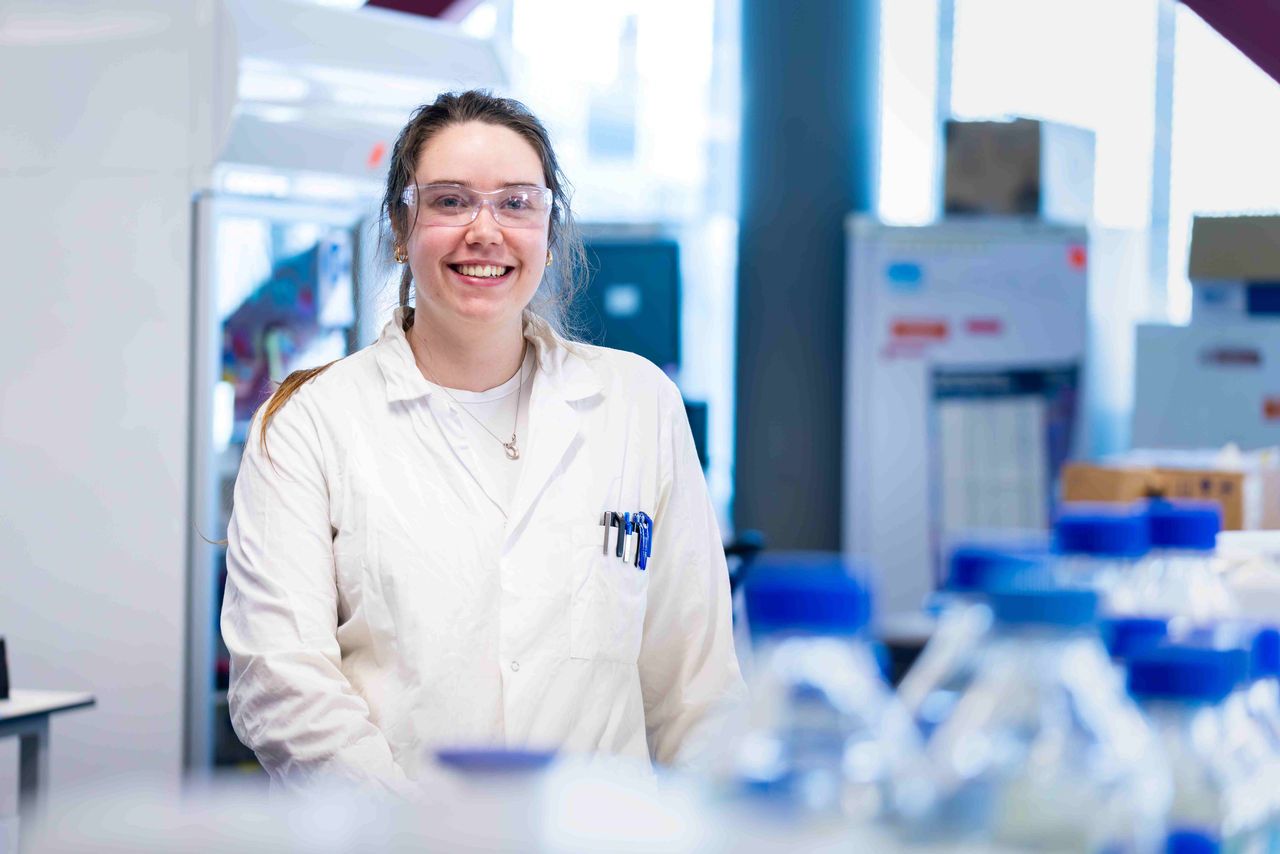
In a University of Canterbury (UC) science lab, postgraduate student Sophie Jamieson watches fluorescently tagged proteins light up inside living plant cells, revealing a world normally invisible to the human eye.
This microscopic science could hold the key to helping plants withstand disease and water stress in a changing climate. By tagging specific proteins with fluorescent markers and exposing plant tissue to bacteria, Sophie can observe the cells’ responses.
It’s work that could soon take her abroad. Sophie is exploring a PhD opportunity with a world-leading plant science centre in Belgium, working in collaboration with New Zealand researchers.
“Before I started at UC, I had no idea this was where I could end up. It’s very exciting,” says Sophie, who studied engineering before moving into biological science. She is currently studying a Bachelor of Science with Honours in Biotechnology.
“I’ve always had a special love for science, and I wanted to see where it could lead. Plant science jumped out at me as plants are the central link to so much that we rely on – our food, our air, agriculture.
“My research focuses on plant responses, which looks at proteins involved in recognising and responding to water stress and pathogens. As climate conditions become more unpredictable, plants can become more vulnerable to infection.
“How they respond to this changing environment is really important. They can’t get up and run away from any threats. They’re stuck. One infection is all it takes to sweep through an entire crop.”
For Dr Claudia Meisrimler, a UC plant biology lecturer and researcher, Sophie’s work demonstrates how molecular science can contribute to major environmental, population and agricultural challenges.
“Put simply, molecular biology is the study of everything that is tiny. But the impact is significant. We’re investigating real-world questions and looking at the bigger picture. Often that bigger picture is overcoming disease in plants, humans and animals – studying fundamental cell and molecular biology is essential to find answers and solutions,” says Dr Meisrimler.
UC students are working with advanced technology, building industry connections and collaborating with other research institutions in New Zealand and globally.
“We have excellent agricultural biotechnology projects supporting sustainable food production and climate resilience,” Dr Meisrimler adds. “Students are working with researchers in Singapore to blend plant-based materials with cultured animal cells for hybrid meat. They are also using synthetic and molecular biology to develop more effective treatments and improved diagnostic tools for plant, human and animal pathogens.”
Strong industry collaboration is important, she says.
“Industry partners often come to us with ideas, which means our students are investigating tangible, real-world challenges while building valuable industry relationships.”
Opportunities include projects connected with external partners like the Food Transitions 2050 postgraduate school and the Bioprotection Aotearoa Centre of Research Excellence, alongside work with industry organisations such as the Radiata Pine Breeding Company, which has offices on UC’s campus.
Investigating cellular activity at the microscopic level requires cutting-edge technology. UC’s confocal microscope allows students to observe dead and living cells down to 120 nanometres, or 0.00012 mm.
Sophie remembers the first time she saw her cell samples glowing under the confocal microscope, moving and reorganising themselves against environmental threat.
“It was monumental. There are so many things we don’t yet know. I would love to keep working on making plants more resilient, to help them grow in different places and withstand pressure from the environment.”
Source: University of Canterbury


